

We’ll help you solve every problem with your toilet
Facing problems with your toilet can be quite frustrating. Does your toilet swirls but won’t flush? We are here to help you overcome this problem. This issue could arise when your toilet bowl isn’t getting enough water from the tank. You can increase the water level in the tank by raising the height of your float.
Understand how the toilet flushes normally
To understand why your toilet doesn’t flush, you need to grasp what happens when it does. There are inlet valves at the rim of your toilet bowl that pours the water coming in from the toilet tank into the bowl.
Every time you flush your toilet, the water level in your bowl is increased and it rises above the P-trap. P-trap is an upward curvature in a pipe situated behind your toilet. This pipe also serves to hold the water at the bottom of your bowl stably.
A seal against the free influx of air is formed when the water flows into the sewer drain. This phenomenon creates suction so that more water flows in that direction. Like this, all the water in the bowl flushes out.
Toilet Swirls But Won’t Flush-Get to know the root of the problem
To flush properly, there needs to be sufficient water in the toilet bowl. In the absence of the required amount, the water in your toilet bowl wouldn’t be able to create the requisite momentum that can flush the toilet.
Insufficient water would not allow the creation of adequate suction so that the water can exit the toilet bowl with force. The escape of water wouldn’t be sufficiently quick.
If your toilet is still swirling, it just implies that water is entering the bowl through the toilet tank. Only the quantity isn’t enough to actually flush out the content.
In this situation, the absence of suction will have the water collected over the crest of the pipe. The only way to build the required suction is to ensure that sufficient water comes in.
Although, the main issue could also be related to your drainpipe. maybe your drainpipe is clogged so the water wouldn’t drain even if its level rises in the toilet bowl. In such a scenario, you ought to clear the blockage in your drain pipe so that your toilet may flush.
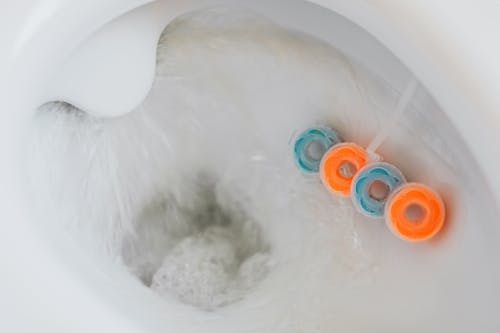
Explore the reasons behind the insufficiency of water in the bowl
Discovering that your toilet isn’t flushing can be quite frustrating. The lack of sufficient water in your toilet tank can have several explanations.
Clogged inlet valves
It is possible that you are facing this problem because your toilet’s inlet valves are clogged. Maybe your valves have been obstructed by a gradual build-up of minerals. These deposits could be preventing the free flow of water into the toilet bowl and causing the inability to flush.
You can easily get rid of such a blockage by pouring agents that destroy such deposits in the valves. The most commonly used substance for this purpose is muriatic acid. Pour muriatic acid into the overflow tube and give it some time to act. Check the status of your toilet’s flushing after about half an hour.
There is another method that does not involve the use of such harmful acids. You can utilize your friendly vinegar.
Step 1: Heat vinegar
You require hot vinegar for this task. So heat up several cups of vinegar and pour them into the overflow pipe. Then give it time to rest.
Step 2: Clear the blockage
Take the help of a stiff wire to clear out the blockage. The inlets under your toilet bowl’s rim need to be cleared.
Step 3: Employ a water softener
The formation of such stubborn build-ups is related to the presence of hard water in your supply. It is suggested that you utilize adequate water softeners that’ll prevent such problems in the future.
Inadequate float ball
It is possible that your float ball is not situated at the correct position and that affects the water level in your toilet tank. This could create issues while flushing your toilet. You ought to adjust the position of the float ball so that the right amount of water enters the toilet bowl during flushing.
Step 1: Check the tank’s water level
Foremost, you ought to check the level of water in the toilet tank. To remove the tank’s lid and keep it aside to see clearly. The water level is normal when it is one inch below the overflow tube.
Step 2: Remove water from the toilet tank
You’ll need to remove all the water from the toilet tank. For this, you’ll first have to turn off the water shut-off valve. You can then repeatedly flush the toilet so that all the water escapes.
Step 3: Check the condition of the float ball
Examine the condition of the float ball and see if it is damaged. A damaged float ball will have to be replaced. Also, examine the high or low position of the float ball in the toilet tank.
Step 4: Adjust the height
If your float ball is intact and has incurred no damage, carefully adjust its height to the correct level. This can be done with the help of a screwdriver by turning the screw on the valve in a clockwise direction. You can then turn on the water supply to the tank again and see if the flushing has returned to normal.
Issues with the flapper
It is possible that this problem is related to your toilet’s flapper. The flapper covers a hole in the toilet tank and forms an adequate seal. It is visible when the tank lid is taken off. The role of the flapper is to prevent the water from escaping the tank when the toilet isn’t being flushed. But if your flapper is damaged, water can slowly leak out of the tank.
This would result in a lower water level of your toilet tank and thereafter create problems while flushing. Although, you can conveniently fix your toilet’s flapper by following these steps:
Step 1: Re-hook to another hole
Your first step would be to re-hook the flapper to another hole that is conveniently approachable by the flush lever. About ½” extra distance must be maintained.
Step 2: Install a new flapper
Remove your old and damaged flapper and replace it with a new one. You can easily find a new flapper at any other hardware store.
Get to know the other reason why your toilet may not be flushing adequately
Clogged drain pipe
Such problems in flushing can also arise because of a blockage in the drain pipe. Certain sticky materials or expandable substances can collect inside your drain pipe. You can clear such a clog on your own.
Step 1: Pour water into the toilet bowl
Pour a lot of water into the water bowl. Probably a bucket full of water. Pour it in a way that a large amount of water enters the bowl at once without any water overflowing onto the bathroom floor.
Step 2: Plunge
After pouring buckets full of water down your toilet, plunge with the help of a plunger and try to break down the blockage.
Step 3: Utilize an auger
If the plunger does not adequately remove the clog in your toilet, utilize an auger. Push the auger until the drainpipe and turn it in a clockwise direction so that it catches all the blocking agents. You can then pull out the instrument and remove the blockage.
Improperly installed drain pipe
It is possible that the installation of your drainpipe is incorrect. This would also cause problems while flushing the toilet. If your pipes are improperly installed and do not follow the correct size, they could be more prone to clogging and create slow draining problems in your toilet.
Too much slack in the lift chain
In case your lift chain has a lot of slack, it’ll not be easy to lift the flapper every time while flushing the toilet. If this is the problem, you ought to shorten the length of the lift chain so that it can provide the required pull and allow the unperturbed flow of water during flushing.
Location of your toilet
It is commonly seen that the toilets on higher stories flush faster and more conveniently than those on the ground floor or in the basement. This phenomenon is related to the effect of gravity on flushing. The higher the location of the toilet, the more is the effect of gravity so that more water is pushed into the drain and the flushing occurs with more momentum.
Conclusion
There could be numerous reasons behind a toilet that won’t flush. But luckily, all of them can be easily solved. You can get over this annoying problem with some extra time, effort, and the right instructions. Be careful to not flush any waste into your toilet that may create a blockage sometimes.